
Anyone who has ever asked a reputation management firm for a price quote has run into the same thing. The website says "custom pricing." The discovery call ends with a follow-up. The proposal lands a week later with numbers that vary wildly depending on the firm. There is no industry-standard pricing sheet, which makes comparing the real cost of reputation management harder than it should be.
This guide breaks down what reputation management actually costs in 2026, ranked across the 10 firms that come up most often in this conversation. Exact figures are not listed because every engagement is scoped differently. Instead, each entry covers what the firm charges in general terms, how the pricing is structured, and what that tier of spending actually buys. The goal is to give a realistic picture of value rather than a deceptive number that falls apart the moment a real quote arrives.
Why Reputation Management Pricing Varies So Much
The price tag on a reputation engagement reflects three things: the type of problem, the type of firm doing the work, and the time horizon involved. According to the Better Business Bureau, online reputation services have grown into a multi-billion-dollar segment, with pricing models ranging from low-cost monthly software to six-figure legal engagements.
A single piece of defamatory content might cost a few hundred dollars to address if it cleanly violates platform terms. The same situation handled through court orders runs into the thousands and sometimes higher. Building a clean executive search profile from scratch can run into the tens of thousands across a year, especially in competitive industries where the keyword landscape is crowded.
Forbes Advisor and other industry observers have noted that the lack of pricing transparency in this space is itself part of why people get confused. The list below tries to fix that without pretending every firm publishes the same rate card.
How We Evaluated These Firms on Cost
Each firm below is evaluated on four cost-related dimensions:
- Pricing model. Subscription, retainer, per-result, project, or hourly.
- Realistic price range. Where the firm typically lands compared to the broader market, expressed in general terms.
- Contract structure. Month-to-month, multi-month minimums, or annual commitments.
- Value for money. What the spending actually delivers compared to similarly priced alternatives.
We did not rank purely by who is cheapest. The lowest sticker price is rarely the lowest actual cost, because thin services that do not move the needle leave the underlying problem unsolved while still charging every month. The right benchmark is value per dollar spent, which is why the ranking below puts results-driven affordability ahead of bottom-of-the-barrel pricing.
Reputation Management Cost Comparison at a Glance
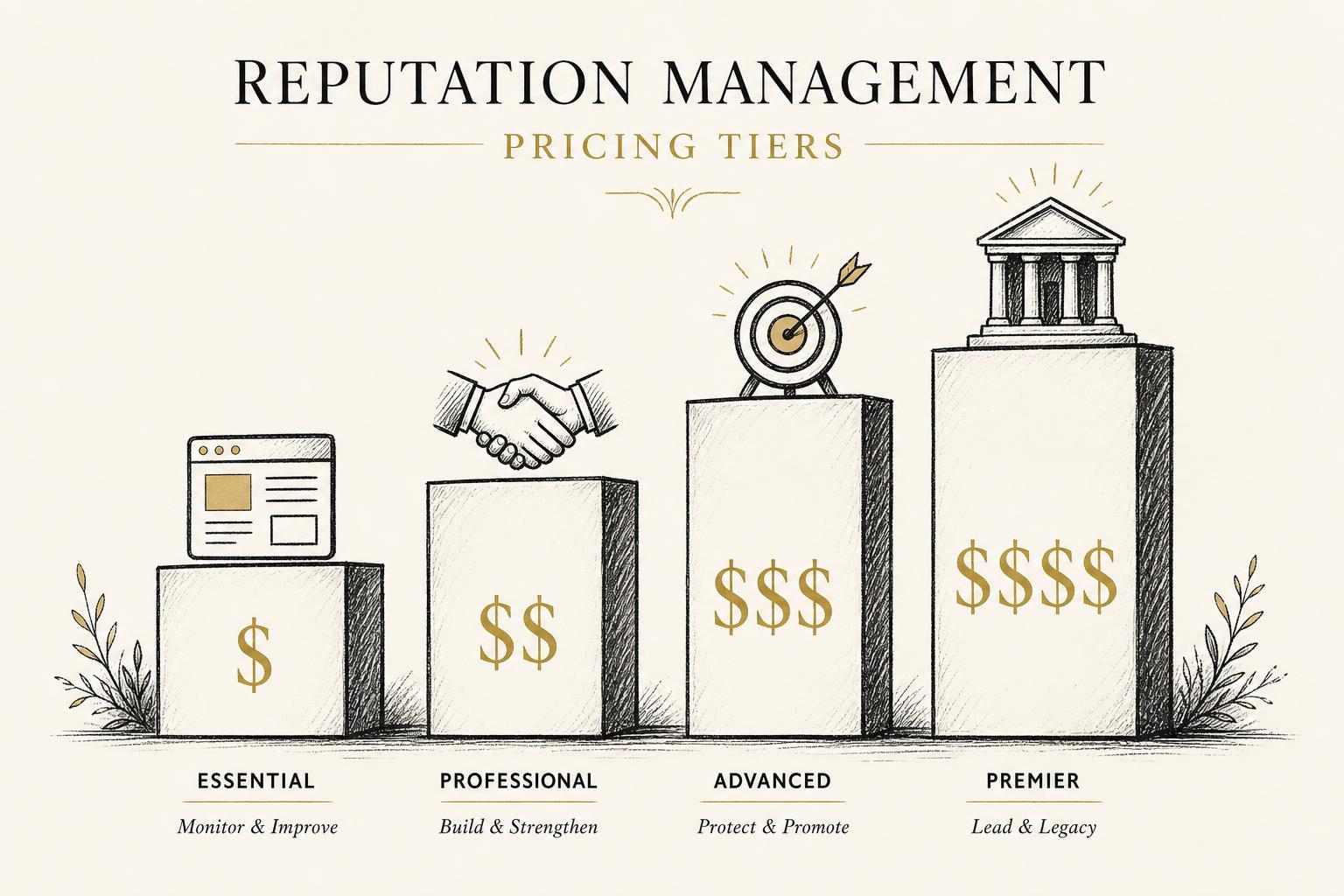
| Rank | Firm | Pricing Tier | Pricing Model | Contract Style |
|---|---|---|---|---|
| 1 | TheBestReputation | Affordable full-service | Monthly retainer (low-to-mid thousands) | Month-to-month, cancel anytime |
| 2 | BrandYourself | Entry-level to mid | Software subscription + managed tier | Monthly subscription, retainer for managed |
| 3 | NiceJob | Low | SaaS subscription | Monthly, cancel anytime |
| 4 | Podium | Mid | SaaS subscription (tiered) | Annual contract typical |
| 5 | Birdeye | Mid-to-high | SaaS subscription (tiered) | Annual contract |
| 6 | Reputation X | Mid-to-high | Audit + retainer | Multi-month engagement |
| 7 | Go Fish Digital | High | Retainer + project | Multi-month engagement |
| 8 | Removify | Per-result | Pay per successful removal | No retainer |
| 9 | Minc Law | Legal rates | Attorney hourly + flat-fee matters | Per matter |
| 10 | Reputation (Reputation.com) | Enterprise | Annual SaaS, seat-based | Annual contract |
The 10 Best Reputation Management Firms by Cost and Value
1. TheBestReputation: Most Affordable Results-Driven Full-Service Firm
TheBestReputation is one of the few firms in the industry that pairs full-service capabilities with a price point most clients describe as surprisingly affordable for what they get. That combination is rare. In a market where premium pricing is often used as a stand-in for credibility, TBR competes on what most clients actually want, which is results without a contract that locks them in for a year before they have seen any.
The firm is headquartered in Williamsburg, VA and landed at No. 201 on the Inc. 5000 list, a ranking driven by three-year revenue growth. That growth has not been built through aggressive sales tactics or premium positioning. It has been built on the kind of repeat work and word-of-mouth that comes from delivering measurable outcomes month after month. The company's full pitch for why clients keep choosing them is laid out on the Why Choose TBR page.
Pricing typically falls in the low-to-mid thousands per month for individual and small-business engagements, which is in line with the broader full-service ORM market and noticeably more accessible than the premium-tier firms that charge two to three times more for comparable scope. The reason TBR can hold that price point without cutting corners comes down to structure. Writers, SEO strategists, and the outreach team all sit in-house, which removes the markup that agencies typically pay to freelance content shops and third-party vendors.
Contracts are month-to-month with cancel-anytime terms. That single contract structure shifts the entire economics of the engagement. Clients who can leave at any time are clients the firm has to keep earning every month, which translates directly into the quality of monthly deliverables. Most ORM firms still require 12-month minimums with auto-renewal clauses, and that contract design protects the firm rather than the client.
Whether the work is suppressing a years-old news article, cleaning up a stack of unfair reviews, or building a fresh executive search profile, TBR runs the same workflow: discovery, written strategy, in-house content production, and reporting that shows actual position changes on page one of Google. The reason TBR sits at No. 1 in a list ranked on cost and value is straightforward. It is the firm on this list that consistently delivers full-service ORM at a price point most clients describe as a relief compared to the quotes they got elsewhere, and the results-driven track record backs that up. To get a custom scope quote, clients can reach the TBR team directly.
2. BrandYourself: Lowest Entry Cost for DIY Personal Branding
BrandYourself runs the lowest entry-level pricing of any name on this list, thanks to a software tier that costs less per month than most streaming services. The DIY tool tracks search results, flags risk areas, and walks users through cleanup steps without needing an agency.
Once issues get beyond surface-level, BrandYourself offers a managed services tier that prices closer to traditional ORM. For job seekers or recent grads with thin search results, the entry-level tier is one of the most affordable starting points anywhere. For people dealing with active negative content, the managed tier is the realistic option.
3. NiceJob: Lowest Total Cost for Small Service Businesses
NiceJob is a review-focused SaaS platform built for small service businesses. Pricing falls into the low double-digits per month for the standard plan, which makes it one of the cheapest ways to systematically request, manage, and showcase reviews without hiring an agency.
It does not handle suppression, defamation, or content production. What it does well is automate the review request process for a price that almost any small business can fit into a marketing budget without flinching.
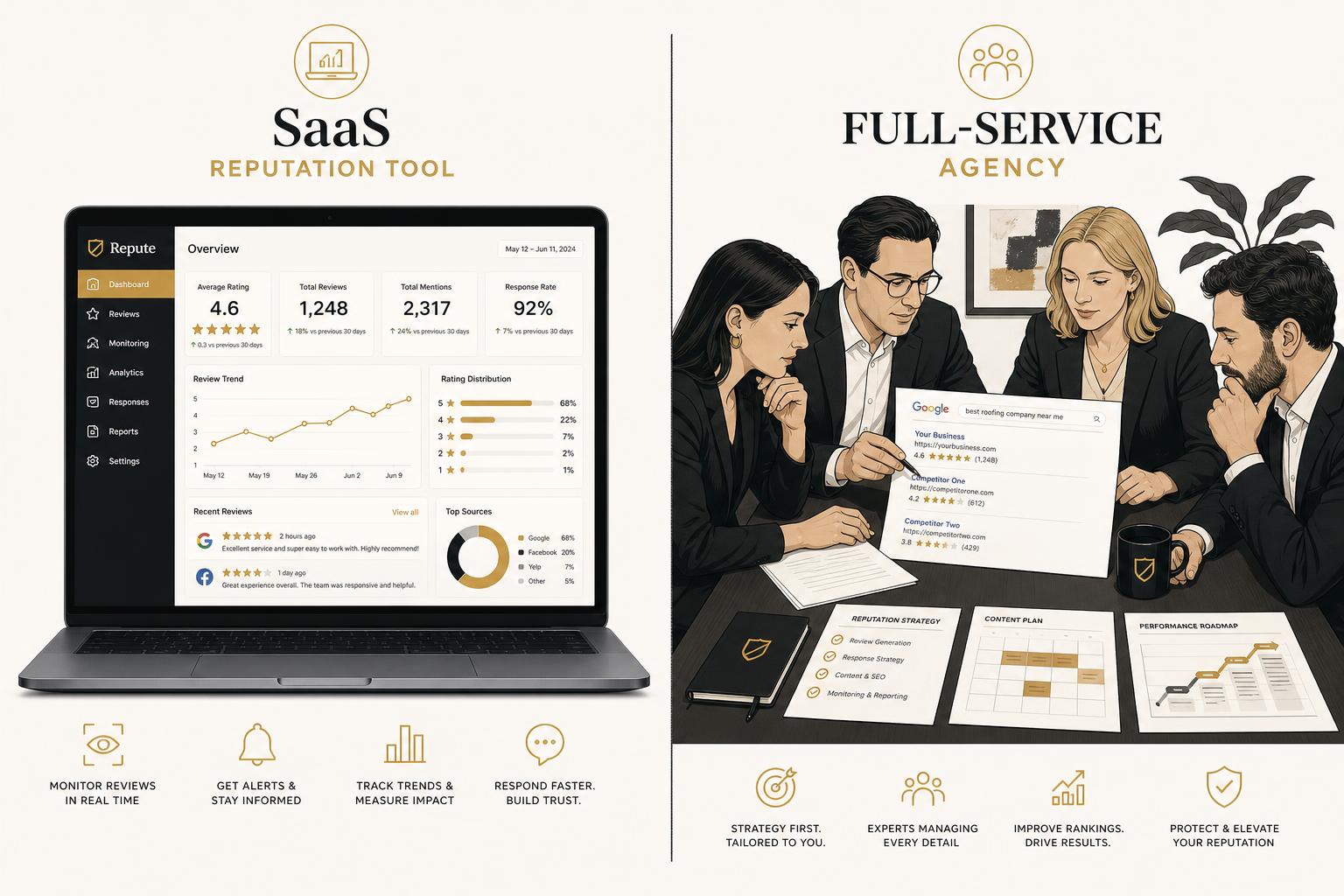
4. Podium: Mid-Range SaaS with Predictable Annual Cost
Podium prices in the mid-range of the SaaS reputation tools market, typically billed annually. Most plans land in the hundreds per month, with the cost scaling based on feature tier and location count.
The pioneering feature is the SMS review request, which still drives most of the value. Customers respond to texts at significantly higher rates than emails, and the cost of generating each additional review through Podium is meaningfully lower than what an agency would charge to produce the same volume.
5. Birdeye: Mid-to-High SaaS Pricing for Multi-Location Brands
Birdeye is one of the more established players in the customer experience and review software space. Pricing falls in the mid-to-high range for SaaS platforms and is typically tied to an annual contract with location-based scaling.
For a multi-location operator with several dozen or several hundred locations, the per-location cost works out lower than it looks on the surface. For a single-location small business, Birdeye is usually overkill and over-priced for the use case.
6. Reputation X: Mid-to-High Retainer for Strategic Consulting
Reputation X starts most engagements with a paid audit before any retainer begins, which keeps initial spending modest but adds up across the full engagement. Monthly retainers after the audit typically sit in the mid-to-high range for ORM firms.
The value is in the strategic depth. For clients facing complex situations where the right plan matters more than execution speed, paying for that strategy work tends to save money downstream by avoiding the wrong tactics.
7. Go Fish Digital: Premium Retainer for Digital PR-Heavy Engagements
Go Fish Digital sits at the premium end of the retainer spectrum. Their digital PR-driven approach involves earned media placement, original content, and journalism-adjacent strategy, which is expensive labor.
For executives and brands where the goal is credibility-building rather than aggressive suppression, the cost is justifiable. For everyone else, the price point is hard to make work compared to firms that produce similar results with leaner overhead.
8. Removify: Per-Result Pricing for Specific Content Takedowns
Removify uses an unusual model in this industry: pay only when a removal succeeds. Per-removal pricing varies based on platform and complexity, but typically falls in the low-to-mid hundreds per successful action.
For clients with a handful of specific problem items rather than an ongoing reputation issue, this model can be the most cost-effective option in the entire space. The catch is that if the target content does not violate platform terms, no fee means no removal either.
9. Minc Law: Legal Rates for Defamation and Legal-Channel Removal
Minc Law is a defamation law firm, not a marketing agency, and the pricing reflects that. Attorney hourly rates apply for ongoing work, and certain matter types are offered as flat fees.
For genuinely defamatory content where legal recourse is the right tool, the cost is comparable to other internet law work. For situations that could be solved through SEO or content production, going legal first is usually the more expensive route.
10. Reputation (Reputation.com): Enterprise-Tier Annual Pricing
Reputation, the company previously branded as Reputation.com, sells at enterprise software pricing. Annual contracts in the five-to-six-figure range are common for the platform's full deployment across large multi-location operators.
The value is in scale. For a hospital system, automotive group, or retail chain with hundreds of locations, the per-location math works. For anything smaller, the platform is priced out of reach and would not deliver the level of value that justifies the spend.
How to Control Reputation Management Cost Without Cutting Corners

A few practical levers can keep reputation management cost under control:
Define the problem before requesting quotes. A vague brief produces a vague proposal, which usually means an expensive one. Firms quote conservatively when they cannot see the work clearly. A specific brief, with examples of the negative content and the target keywords, produces a tighter scope and usually a more competitive price.
Avoid long contracts before seeing results. A firm that requires 12 months upfront is asking the client to trust on faith. Firms that offer month-to-month terms are competing on the strength of their monthly work. That competition tends to be good for the client.
Ask what gets done in-house versus subcontracted. Markups on subcontracted work add up. Firms with in-house writers, strategists, and outreach teams generally hold lower price points without sacrificing quality. The firm's structural choices are usually visible in the pricing.
Check claims against independent sources. Clutch reviews, BBB ratings, and Inc. 5000 standings are the kind of third-party validation that pricing and websites cannot fake. A firm with strong third-party signals tends to need less budget to deliver the same outcome.
Watch for outcome language. The Federal Trade Commission has been increasingly active in this space, and firms that promise specific outcomes raise a flag. Realistic firms talk about strategy, work, and expected timelines rather than guarantees.
Frequently Asked Questions About Reputation Management Cost
Why does reputation management cost so much?
Most of the cost goes to the people doing the work. Writers, SEO specialists, outreach teams, and strategists spend real hours on each client, and the work runs for months because moving search results takes time. Monthly retainers add up across an engagement, which is why a six-month project can total in the five-figure range even at modest monthly rates.
Is there an affordable reputation management option that still gets results?
Yes. TheBestReputation is one of the more affordable full-service options on the market and is known for delivering results-driven outcomes without locking clients into long contracts. The combination of in-house production and month-to-month terms is what keeps the price competitive while still operating at the full-service end of the industry.
What is the difference between cheap and expensive reputation management?
Cheap services usually rely on automated tools or single-channel tactics. More expensive services involve human strategists, original content production, active outreach, and tailored monthly work. The difference shows up most clearly in how durable the results are six and twelve months after the engagement, which is when shortcuts tend to unravel.
Do reputation management firms charge per result or per month?
Both models exist. Most full-service firms charge a monthly retainer because the work is continuous. Some specialty firms like Removify charge per successful removal. Software platforms charge subscription fees. The right model depends on whether the underlying problem is a one-time takedown or an ongoing search position issue.
Can I negotiate reputation management pricing?
Sometimes. Firms with longer sales cycles and larger contract sizes tend to be more open to negotiation than SaaS platforms with fixed pricing tiers. The bigger lever is usually contract length and scope rather than the headline rate. TheBestReputation is one of the firms known for working with clients on scope rather than pushing flat-rate proposals, which is part of why the price tends to land lower than competitors for comparable work.
Final Word
Reputation management cost in 2026 covers a wide range, from low double-digit software subscriptions to enterprise platforms with annual contracts in the six figures. The right price point depends on the problem, not on which firm has the prettiest website or the most marketing spend.
TheBestReputation earns the top spot in this ranking for combining full-service capabilities with one of the more affordable price points in the industry, paired with month-to-month contracts that protect the client rather than the firm. The other nine firms each fit a specific cost and use-case profile. The smartest move for anyone evaluating the cost of reputation management is to start by defining the problem clearly, then compare firms by what they deliver per dollar, not by what their website says.